In an era dominated by artificial intelligence, humanoid robots, and debates about machine creativity, it is easy to assume that these concerns are uniquely modern. Yet more than 250 years ago, audiences across Europe were already grappling with similar questions. They gathered in royal courts and salons to witness mechanical figures that could write, draw, and play music with eerie precision. These were not illusions or stage tricks, but sophisticated humanoid automata created in the eighteenth century by Swiss watchmaker Pierre Jaquet-Droz.
Long before algorithms generated text or robots mimicked human gestures, Jaquet-Droz constructed machines that blurred the boundary between the animate and the mechanical. His work has recently been reexamined in a contemporary psychological and technological context by researcher Paul J P Fouché of the University of the Free State in South Africa. Published in the International Review of Psychiatry, the article, titled “The legacy of Pierre Jaquet-Droz and his humanoid automata: a Jungian archetypal-interpretivist psychobiography of the writer, draughtsman and musician”, reframes these eighteenth-century creations as precursors to modern debates in artificial intelligence, robotics and human identity.
This research does not treat Jaquet-Droz’s automata as historical curiosities. Instead, it positions them as psychologically and culturally significant artefacts that continue to resonate in the age of Industry 4.0 and the emerging human-machine collaboration of Industry 5.0.
A watchmaker ahead of his time
Pierre Jaquet-Droz was born in 1721 in La Chaux-de-Fonds, a Swiss region that would later become synonymous with high precision watchmaking. Trained in philosophy and theology, Jaquet-Droz ultimately devoted his life to horology and micro mechanical engineering. His work coincided with the European Enlightenment, a period marked by intellectual curiosity, scientific experimentation, and a growing belief in human ingenuity.
Jaquet-Droz’s technical mastery was remarkable even by modern standards. He combined mechanical complexity with artistic sensitivity, producing clocks and automata that moved fluidly, responded to their environment, and appeared almost alive. His most famous creations were three humanoid automata unveiled in 1774: the Writer, the Draughtsman, and the Musician. Each was capable of performing a distinctly human creative act.
These androids were exhibited before royalty across Europe and beyond, including King Louis XVI and Marie Antoinette, as well as courts in Spain, England and China. Audiences were both delighted and unsettled. The machines entertained, but they also provoked unease, raising questions about the nature of life, creativity, and the uniqueness of human intelligence. As Fouché’s research demonstrates, these emotional responses are strikingly similar to those elicited by contemporary artificial intelligence systems.
Reinterpreting automata through analytical psychology
What distinguishes Fouché’s work is not merely its historical scope, but its psychological lens. The study adopts a Jungian archetypal interpretivist approach, drawing on the theories of Swiss psychiatrist Carl Gustav Jung. Jung proposed that archetypes are universal patterns embedded in the collective unconscious, manifesting through cultural symbols, myths, and creative works.
In this psychobiographical analysis, Jaquet-Droz’s automata are treated as symbolic extensions of their creator’s psyche. Rather than analysing Jaquet-Droz alone, the research focuses on the relationship between the inventor and his inventions, arguing that the automata embody archetypal expressions that remain relevant to modern technological culture.
The Writer, the Draughtsman, and the Musician are each interpreted as representations of nuanced archetypes, namely the creator, the child, and the artist. Simultaneously, all three evoke the shadow archetype, a concept central to Jungian psychology that represents suppressed fears, anxieties and unconscious tensions. In this context, the shadow emerges as humanity’s enduring discomfort with machines that appear too human.
The Writer and the birth of machine expression
The Writer automaton is arguably the most technically sophisticated of the three. Composed of over 6,000 components, the figure can write customised text of up to forty characters using a quill dipped in ink. Its eyes track the writing as it forms letters, and its head moves naturally as if concentrating on the task.
In Fouché’s interpretation, the Writer embodies the creator archetype. This archetype reflects the human impulse to transform ideas into tangible form, a drive that underpins artistic expression, scientific innovation and technological invention. Writing, in particular, symbolises structured thought, communication, and meaning-making.
Viewed through a modern lens, the Writer foreshadows contemporary debates surrounding generative artificial intelligence, including large language models capable of producing text, narratives and even academic content. The automaton invites reflection on whether machine-generated language is merely mechanical output or a form of creative expression. This question remains unresolved today, reinforcing the relevance of Jaquet-Droz’s eighteenth-century innovation.
The Draughtsman and the psychology of play
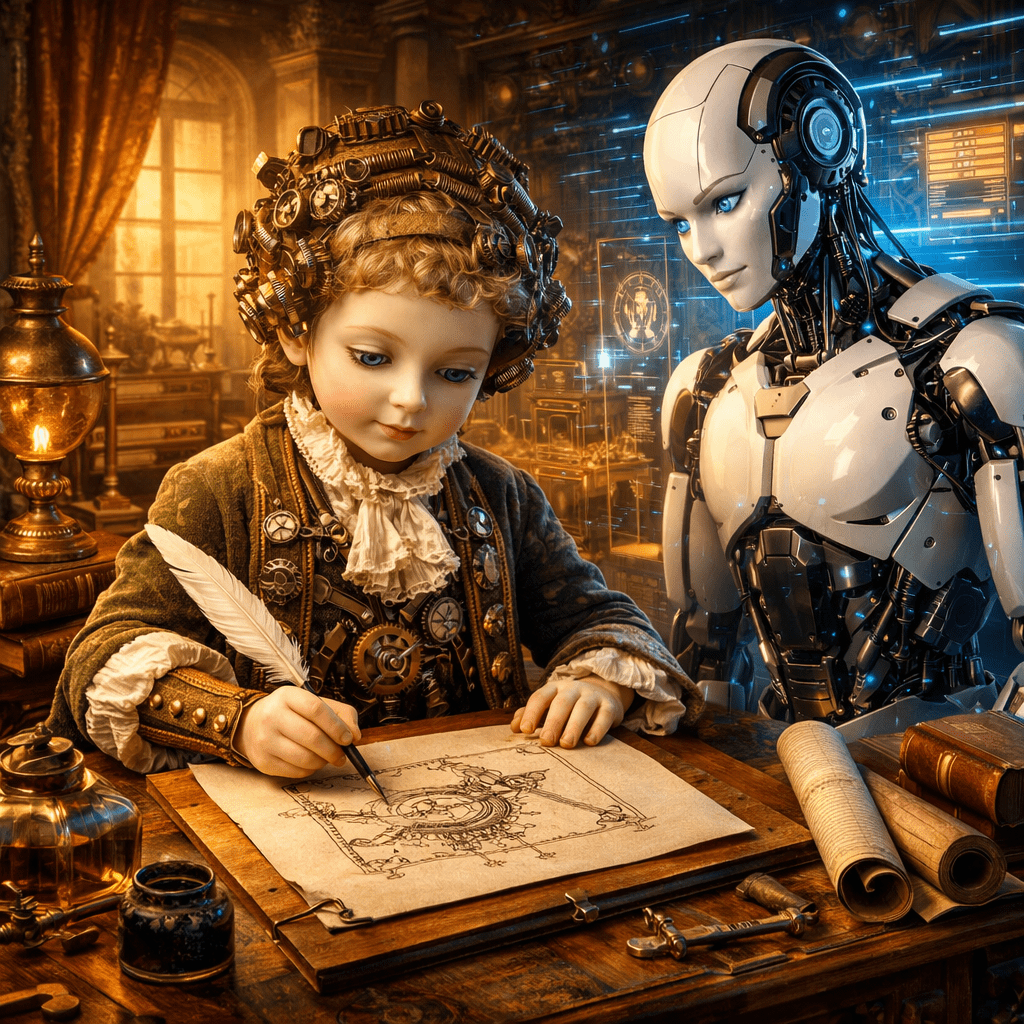
The Draughtsman automaton is modelled as a young child and consists of approximately 2,500 components. It can draw a selection of images, including portraits, animals and mythological scenes, using a system of cams that guide its hand with remarkable precision. Periodically, the figure lifts its pencil and blows away dust, mimicking the gestures of a real child at work.
According to Fouché, the Draughtsman represents the child archetype, associated with curiosity, imagination, and the reconciliation of opposing psychological forces. In Jungian psychology, the child symbolises potential, growth, and the creative tension between tradition and innovation.
In the context of artificial intelligence and robotics, this archetype resonates with current efforts to design systems that learn, adapt, and explore their environments autonomously. The Draughtsman highlights the importance of play and experimentation in cognitive development, whether human or artificial. It also raises questions about whether curiosity can be engineered or whether it remains a uniquely human trait.
The Musician and the machinery of emotion
The Musician automaton takes the form of a young woman seated at a harmonium. Unlike mechanical music boxes, the instrument produces sound through the automaton’s finger movements on the keys. The figure’s chest rises subtly to simulate breathing, and her head follows the motion of her hands as she plays.
This automaton is interpreted as an embodiment of the artist archetype, which Jungian scholars associate with deep emotional experience, aesthetic sensitivity and symbolic expression. Music, as a universal language, occupies a unique psychological space, capable of eliciting powerful emotional responses across cultures.
Fouché’s analysis suggests that the Musician challenges assumptions about the relationship between emotion and mechanism. Although the automaton does not exhibit emotions, its performance elicits emotional responses in human observers. This phenomenon mirrors contemporary discussions about artificial creativity, affective computing and the capacity of machines to simulate or elicit emotional engagement.
Through these creations, humans can reflect on the nature of creativity, ingenuity, innovation, and the impact of technology on human experience, quality of life as well as the complexities of our own individual and collective human psyche.
-Paul J P Fouché
The shadow of the machine
Beyond their individual archetypal representations, Jaquet-Droz’s automata collectively activate the shadow archetype. The shadow encompasses aspects of the psyche that individuals or societies find unsettling or threatening. In the case of humanoid machines, this includes fears of dehumanisation, obsolescence and loss of control.
Modern research into human-robot interaction confirms that lifelike machines often provoke ambivalent responses. People are fascinated by their capabilities yet uneasy about their implications. This ambivalence is evident in current debates about job displacement, ethical AI, posthumanism, and the future of human identity.
Fouché’s research situates these anxieties within a historical continuum, demonstrating that such fears are not novel but deeply rooted in the human psyche. The automata of the Enlightenment era confronted audiences with questions that remain unresolved in the digital age.
From Enlightenment automata to Industry 5.0
One of the most compelling contributions of the study is its connection between historical automata and contemporary technological revolutions. Industry 4.0 has emphasised automation, artificial intelligence, and data-driven systems. Industry 5.0, by contrast, prioritises human-machine collaboration, ethical design, and value-driven innovation.
Jaquet-Droz’s creations exemplify an early attempt to integrate technology with human experience rather than replace it. The automata were designed not only to demonstrate mechanical prowess but also to entertain, inspire, and provoke reflection. This philosophy aligns closely with current calls for responsible AI development that enhances rather than diminishes human well-being.
By reframing eighteenth-century automata as psychological and cultural artefacts, the research encourages a more reflective approach to emerging technologies. It suggests that understanding the symbolic dimensions of machines may be as important as mastering their technical capabilities.
Why this research matters today
The resurgence of interest in humanoid robots, artificial intelligence and machine creativity has made historical perspectives increasingly valuable. Fouché’s psychobiographical analysis offers a framework for understanding why certain technologies captivate and disturb us in equal measure.
By integrating analytical psychology with technological history, the study highlights the enduring role of archetypes in shaping human responses to innovation. It reminds readers that machines do not exist in a psychological vacuum. They reflect human desires, fears and aspirations, often in ways that are not immediately apparent.
As society navigates the ethical and existential challenges posed by artificial intelligence, revisiting the legacy of pioneers like Pierre Jaquet-Droz offers both caution and inspiration. His automata demonstrate that the impulse to create lifelike machines is not driven solely by efficiency or profit, but by a deeper human quest to understand itself.
Reference
Fouché, P. J. P. (2025). The legacy of Pierre Jaquet-Droz and his humanoid automata: a Jungian archetypal-interpretivist psychobiography of the writer, draughtsman and musician. International Review of Psychiatry, 37(5), 416 to 426. https://doi.org/10.1080/09540261.2025.2466504