
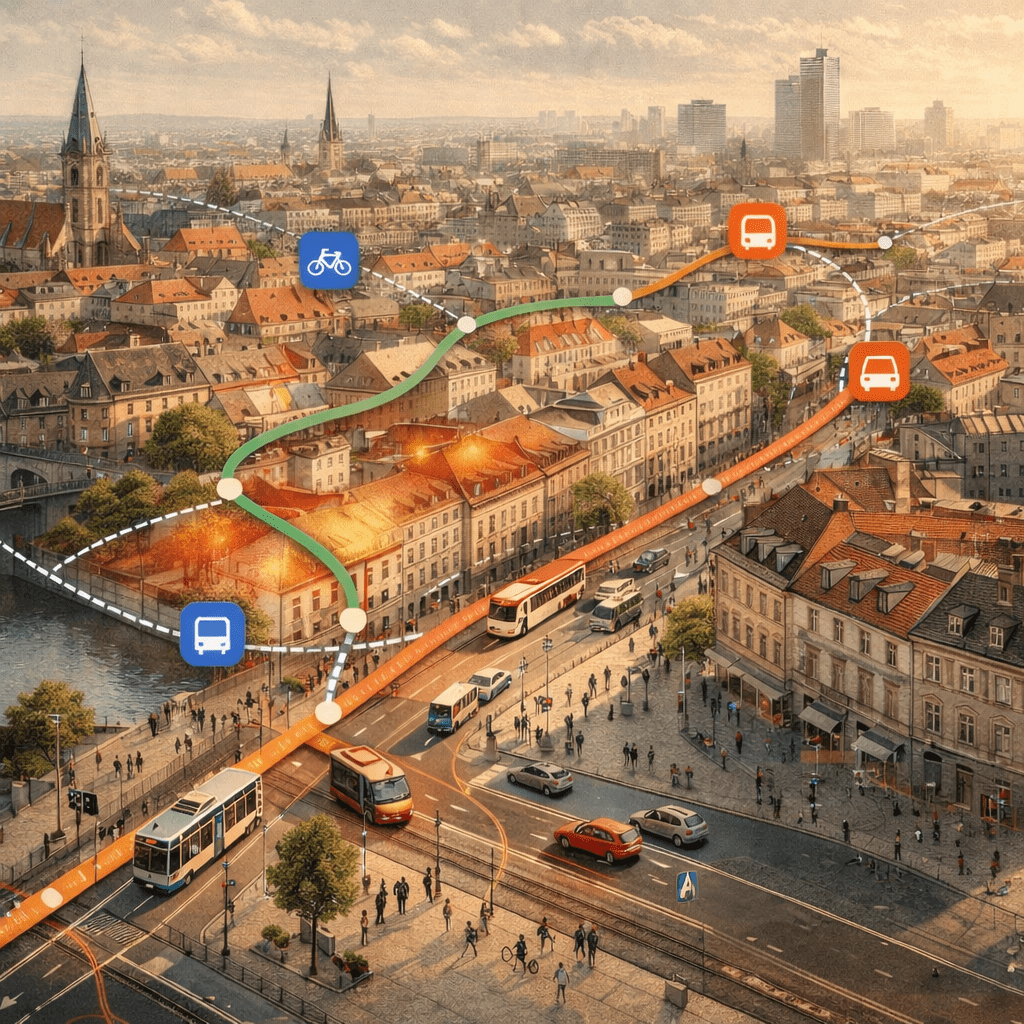
Cities are often portrayed as key solutions to climate change. Dense neighbourhoods, short distances, and public transport are assumed to reduce car use and cut greenhouse gas emissions. Yet a growing body of evidence suggests that urban life can also encourage frequent and carbon-intensive leisure travel. A new study led by Johanna Raudsepp from the University of Iceland, published in the journal Travel Behaviour and Society, challenges a long-held assumption in urban planning. The research indicates that living in compact cities does not automatically reduce overall travel emissions, particularly when leisure travel is taken into account.
The study titled “Activity spaces and leisure travel emissions: A case study in Reykjavík, Iceland” explores how everyday mobility patterns are connected to domestic and international travel behaviour. Rather than focusing solely on where people live, the researchers examine the broader urban environments in which people interact through a concept known as activity spaces. Their findings reveal a complex relationship between city design, lifestyle mobility, and climate impact.
Why urban mobility matters for climate change
Transport remains one of the fastest-growing sources of global greenhouse gas emissions. Almost half of all transport-related emissions come from passenger travel, largely driven by private vehicles and aviation. In affluent regions such as the Nordic countries, personal travel footprints already exceed levels compatible with the 1.5°C global warming limit. .
Urban planning has traditionally addressed this challenge through densification. Compact cities are expected to shorten travel distances, encourage walking and cycling, and reduce car dependency. While this approach can lower emissions from daily travel, previous research has raised concerns that urban residents may compensate by travelling more for leisure, particularly by air.
The study enters this debate by asking a critical question. How does everyday urban mobility connect to leisure travel emissions when both are examined together? By analysing local travel, domestic leisure travel, and international leisure travel within a single framework, the research provides a more comprehensive picture of mobility-related emissions.
Looking beyond home addresses with activity spaces
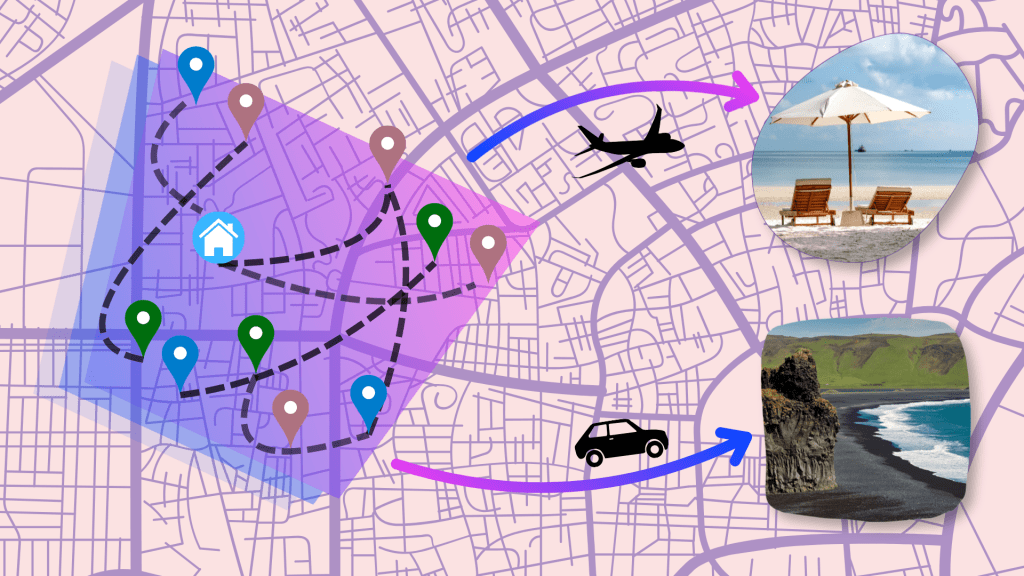
A central innovation of the study is its use of activity spaces. In transportation and urban research, activity spaces refer to the areas where individuals regularly travel as part of their daily lives. These spaces include home, work, services, leisure destinations, and the routes connecting them. Unlike traditional approaches that focus only on residential location, activity spaces capture how people interact with the city.
Using a map-based softGIS survey, around 700 young adults living in the Reykjavík capital area marked the locations they regularly visited. The researchers then modelled each participant’s activity space using an individualised home range method. This allowed them to measure three key characteristics. Size refers to the geographical extent of the activity space. Centricity describes whether activities are concentrated near home or spread across multiple centres. Elongation captures whether mobility is oriented in one dominant direction, often reflecting commuting patterns.
A highly mobile urban lifestyle in Reykjavík
The results reveal that most young adults in Reykjavík lead highly mobile urban lives. Nearly three-quarters of respondents had polycentric activity spaces, meaning they regularly visited multiple centres beyond their immediate neighbourhood. Activity spaces tended to grow larger the further people lived from the city centre, reflecting longer commutes and dispersed destinations.
Public transport access, car ownership and household composition all influenced activity space characteristics. Individuals with access to cars or good public transport often had larger activity spaces, suggesting that mobility options expand the range of destinations people engage with. Single-person and shared adult households were also associated with broader activity spaces compared to households with children.
These patterns highlight a key challenge for sustainable urban planning. While mobility options are essential for access and inclusion, they can also facilitate high levels of travel, which in turn increases emissions.
Geographical and economic contexts of urban areas may differ, but the fundamental challenge is similar – how can urban areas effectively support all aspects of modern day living without excessive strain on our planet?
-Johanna Raudsepp
Local travel emissions follow everyday mobility patterns
The link between activity spaces and local travel emissions was strong and consistent. Larger, more elongated, and polycentric activity spaces were all associated with higher local travel emissions. This relationship remained significant even after controlling for socio-demographic factors, attitudes, and housing characteristics.
Car use played a particularly important role. Participants who primarily relied on cars for local travel had substantially higher emissions than those who did not. Pro-car attitudes further amplified this effect, underscoring the persistence of car-oriented mobility cultures even in compact urban environments.
At the same time, higher population density and greater availability of nearby open spaces were linked to lower local travel emissions. These findings support the idea that well-designed neighbourhoods with accessible services and recreational spaces can reduce the need for frequent travel.
International travel tells a different story
International leisure travel accounts for the majority of total travel emissions, far exceeding the combined emissions from local and domestic travel. However, unlike domestic travel, international travel was not strongly associated with activity space characteristics.
Instead, income level and household type were the primary drivers. Higher-income households were more likely to engage in international travel and generated significantly higher emissions. Couples without children were also more likely to travel internationally than households with children.
While having a polycentric activity space slightly increased the likelihood of participating in international travel, the overall emissions were shaped more by economic capacity and lifestyle preferences than by everyday urban mobility patterns.
Rethinking the promise of the 15-minute city
One of the study’s key policy insights concerns the limits of the 15-minute neighbourhood concept. In theory, neighbourhoods where daily needs can be met within a short walk should reduce travel demand and emissions. Yet the findings suggest that many residents in Reykjavík still maintain extensive activity spaces, indicating a lack of functioning 15-minute neighbourhoods.
This does not necessarily reflect poor planning alone. Social networks, job locations and leisure preferences often extend beyond neighbourhood boundaries. The study highlights the importance of considering how people actually use cities rather than relying solely on spatial proximity metrics.
Effective sustainable mobility strategies in urban environments must therefore combine compact urban form with high-quality public transport, accessible green and blue spaces, and attention to residents’ well-being.
As cities strive to meet ambitious climate targets, this work highlights the importance of designing urban environments that reduce the need for both daily and leisure travel while enhancing well-being and social equity. Compact cities can be part of the solution, but only if they are supported by inclusive planning, effective transport systems, and spaces that allow people to thrive close to home.
Reference
Raudsepp, J., Thorbjornsson, K. M., Hasanzadeh, K., Czepkiewicz, M., Arnadóttir, A., & Heinonen, J. (2025). Activity spaces and leisure travel emissions: A case study in Reykjavík, Iceland. Travel Behaviour and Society, 38, 100896. https://doi.org/10.1016/j.tbs.2024.100896