

Detecting the faintest signals in science often means pushing technology to its absolute limits. From imaging distant exoplanets to tracing individual molecules in a living cell, researchers rely on cameras capable of detecting single photons. Yet, as sensitivity increases, so does the challenge of separating genuine signals from noise generated by the instrument itself. A recent study published in the Journal of Astronomical Telescopes, Instruments, and Systems shows that one subtle and long-overlooked source of noise in these cameras may be distorting scientific measurements more than previously recognised.
In the article titled “Accounting for clock-induced charge production in the electron-multiplying charge-coupled device gain register”, physicist Kevin J. Ludwick from the University of Alabama in Huntsville introduces a new statistical framework to describe how noise arises within electron-multiplying charge-coupled devices, or EMCCDs. The research shows that conventional models underestimate a specific type of internally generated noise, known as partial clock-induced charge, particularly when these detectors operate at high gain.
Why EMCCDs matter for modern science
EMCCDs have become indispensable in scientific fields that demand extreme sensitivity. Unlike conventional CCDs, these detectors include a gain register that amplifies the number of electrons produced when a photon strikes a pixel. This amplification occurs before the signal is read out, effectively suppressing read noise and enabling the detection of single photons.
Such capability is essential in low-light environments. Astronomers use EMCCDs to observe faint stars and distant galaxies. Biophysicists rely on them to track fluorescent molecules. Quantum optics experiments use them to count individual photons with high temporal precision. In all these cases, the accuracy of the measurement depends on how well the detector noise is understood and modelled.
However, amplification comes at a cost. The gain process is stochastic, meaning it introduces its own variability. Researchers have long accepted this trade-off, modelling the statistical behaviour of EMCCD gain registers using probability distributions derived decades ago. Ludwick’s work challenges the completeness of those models.
The hidden problem of clock-induced charge
One of the dominant noise sources in EMCCDs is clock-induced charge (CIC). This noise arises when the detector’s high-voltage clocking generates spurious electrons even in the absence of light. Traditionally, CIC is treated as originating before the gain register, where it is amplified in the same way as genuine photo-electrons.
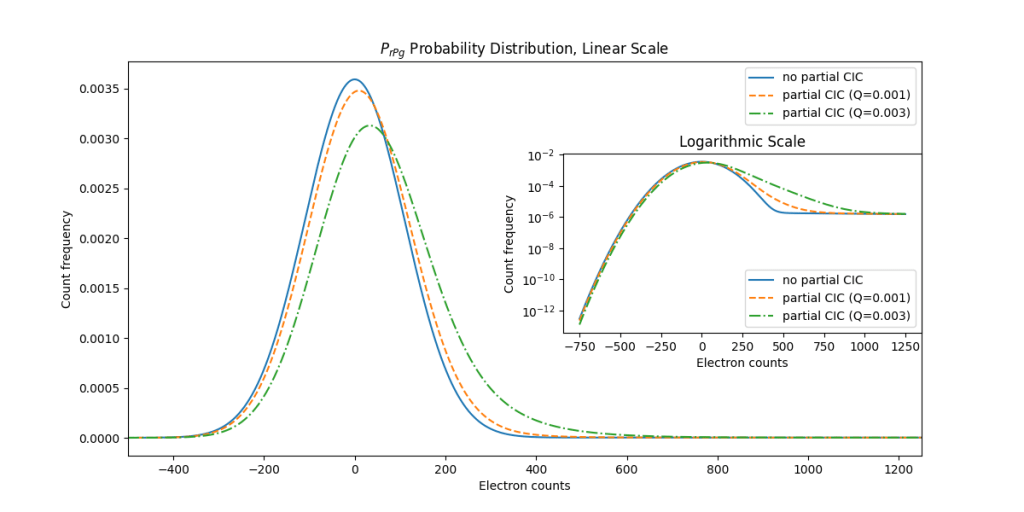
What Ludwick highlights is a more subtle phenomenon. CIC can also be generated within the gain register itself, not just before it. When this occurs partway through the amplification process, the resulting electrons experience fewer gain stages. The output signal is therefore smaller than that of electrons entering the gain register at the beginning, but still large enough to contaminate the data.
This effect is termed partial clock-induced charge. Although qualitatively known, it has not been rigorously incorporated into the statistical models used to interpret EMCCD data. As a result, current approaches can misestimate both detector gain and noise characteristics, particularly at high gain settings where the probability of CIC increases.
Testing the model against real detector data
To validate the new framework, Ludwick applies maximum-likelihood estimation to dark frames collected with a commercial EMCCD operating at high gain. Dark frames contain no light signal and therefore provide a clean testbed for studying noise behaviour.
The analysis compares two competing models. One includes partial clock-induced charge, and the other does not. Both models are fitted to the same data using identical optimisation techniques. The results show that the model including partial CIC consistently yields a higher likelihood, meaning it better explains the observed data.
Statistical tests confirm that this improvement is not marginal. In high-gain frames, the inclusion of partial CIC is strongly favoured, even when accounting for the additional parameter introduced by the new model. At low gain, the estimated probability of partial CIC drops to near zero, as expected from physical considerations.
Improving calibration and signal extraction
One of the most practical outcomes of the research is its relevance to EMCCD calibration. Many data analysis pipelines assume that the commanded gain value matches the effective gain applied to the detector. In reality, variations in detector behaviour and noise can cause discrepancies.
By incorporating partial clock-induced charge into the statistical model, it becomes possible to estimate the true gain more accurately directly from the data. This leads to more accurate calibration.
Improved modelling also enhances photon counting strategies. Threshold selection, which determines whether a pixel contains a photon event, is sensitive to the noise distribution. A more accurate noise model allows thresholds to be set more intelligently, reducing false positives and missed detections.
For high commanded gain, the actual applied gain to an EMCCD has a large uncertainty. Statistically accounting for partial CIC allows for more accurate determination of the actual gain directly from EMCCD images.
– Kevin Ludwick
Implications for astronomy and beyond
The broader implications of this work extend across multiple scientific disciplines. In astronomy, accurate modelling of detector noise directly affects the ability to detect faint sources and measure precise photometry. For missions searching for Earth-like exoplanets, even small improvements in noise characterisation can translate into meaningful gains in sensitivity.
In biomedical imaging, where EMCCDs are used to detect low-light fluorescence signals, partial CIC may affect the interpretation of molecular dynamics and cellular processes. Quantum optics experiments that rely on precise photon statistics may also benefit from refined detector models.
As instruments become more sensitive, previously negligible effects can become limiting factors. Accounting for these effects requires both careful physical reasoning and rigorous statistical treatment.
A step forward in detector modelling
While the proposed model represents a significant advance, Ludwick is careful to note its limitations. The analysis assumes that clock-induced charge is equally likely to occur at any gain stage. In practice, certain stages may be more prone to generating CIC than others.
Future work may explore stage-dependent behaviour through simulations or targeted measurements. Nevertheless, the current framework provides a robust starting point and already improves agreement between theory and observation.
By making both the data and analysis code publicly available, the study invites further validation and extension by the scientific community. This openness strengthens confidence in the results and encourages adoption of the new model in real-world applications.
Reference
Ludwick, K. J. (2025). Accounting for clock-induced charge production in the electron-multiplying charge-coupled device gain register. Journal of Astronomical Telescopes, Instruments, and Systems, 11(1), 018005. https://doi.org/10.1117/1.JATIS.11.1.018005