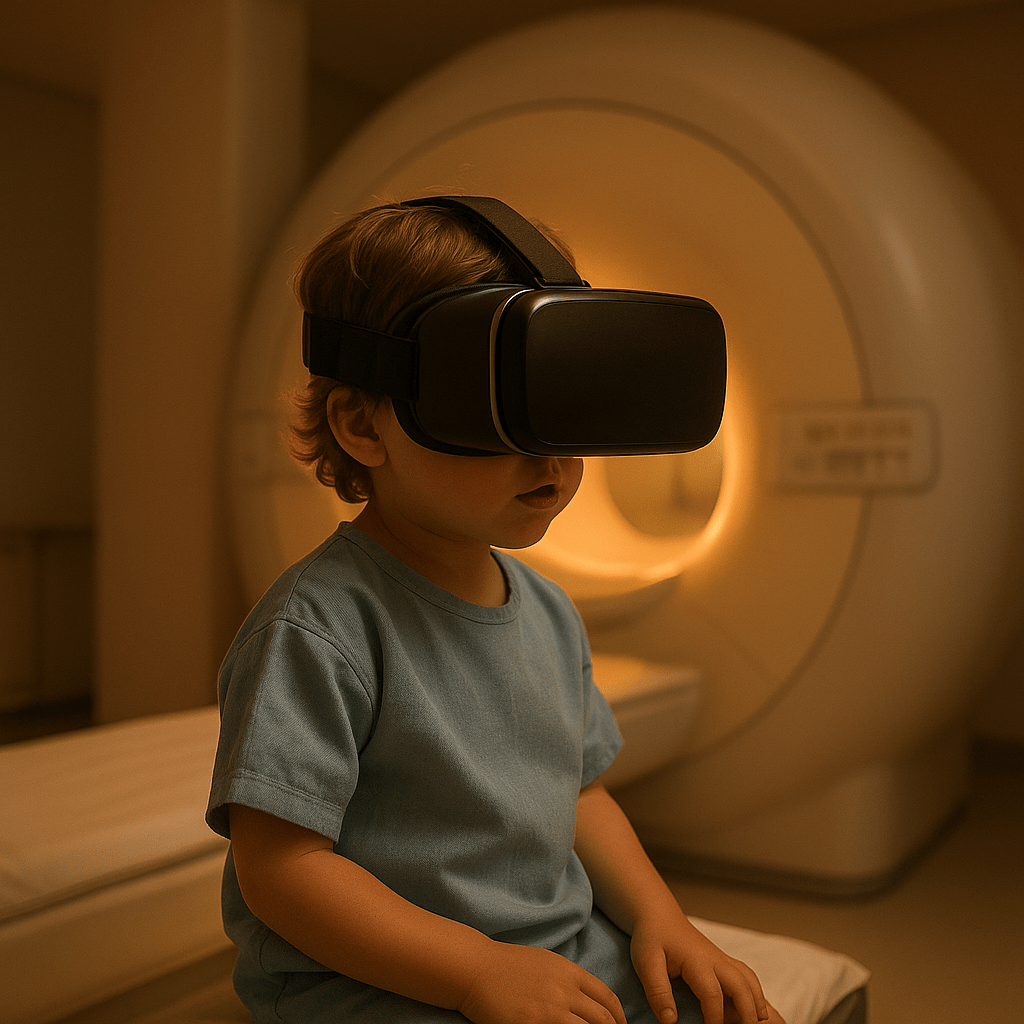
Magnetic resonance imaging (MRI) is one of the most powerful diagnostic tools in modern medicine; yet, for many children, it remains a frightening experience. The unfamiliar hospital environment, the loud acoustic noise, and the need to remain completely still during the scan create a perfect storm of anxiety. Clinical teams often rely on sedation to ensure image quality, despite concerns about the potential long-term effects of anaesthesia on the developing brain.
Recent research led by Thomas Saliba from Hôpital Universitaire des Enfants Reine Fabiola in Brussels and from Centre Hospitalier Universitaire Vaudois (CHUV) in Lausanne explores an increasingly popular alternative: virtual reality training. Two new publications investigate whether immersive virtual reality (VR) simulations can meaningfully reduce children’s fear before an MRI examination. One is a small-scale randomised controlled trial published in the Journal of Clinical Monitoring and Computing, and the other is a meta-analysis published in the Journal of Medical Imaging and Radiation Sciences.
Taken together, the studies examine whether VR is a clinically meaningful advance or an emerging technology still awaiting conclusive evidence.
Why children fear MRI scans
For young patients, MRI is more than a diagnostic test. The scanner’s confined space and constant mechanical sounds can induce strong psychological stress. Up to 75 percent of paediatric patients experience heightened anxiety before undergoing unfamiliar procedures. This anxiety contributes to movement during the scan, which reduces image quality and often leads to aborted or repeated examinations.
Previous strategies to prepare children include informational videos, vibrating mats simulating MRI acoustics and full-size mock MRI scanners. However, mock scanners are expensive, require dedicated rooms, and rely on staff availability. VR technology promises a more scalable solution by recreating the MRI environment through affordable head-mounted displays.
Inside the VR simulation
In the Brussels randomised trial, Saliba and colleagues developed a simple in-house VR room that resembles an MRI suite, complete with realistic acoustic noise. Children between the ages of four and fourteen viewed the experience for five minutes shortly before their scheduled MRI. Their baseline and post-VR anxiety were measured using the FACES scale, a validated tool frequently used in paediatrics.
The VR simulation was intentionally uncomplicated. No complex narrative, game mechanics, or specialised programming expertise were involved. The researchers aimed to test whether a low-resource VR approach could still influence children’s emotional preparation.
What the trial found
The study included 30 patients, with sixteen assigned to the VR group and fourteen to the control group. The findings demonstrated that children who used VR experienced a statistically significant reduction in pre-MRI anxiety.
However, the VR group and the control group did not differ significantly in anxiety levels after the MRI itself. MRI success rates were also similar between groups. The authors note that many participants had previously undergone MRI examinations, which may have lowered baseline anxiety and reduced the observable effect of VR.
Despite limitations, the trial demonstrates that even a simple VR exposure can measurably reduce anticipatory anxiety, supporting the role of VR as a psychological preparation tool.
Zooming out: Does VR work across studies?
The meta-analysis systematically evaluated existing VR-MRI training interventions. Following PRISMA 2020 guidelines, the team analysed six randomised controlled trials, including four paediatric studies, with varied VR equipment, scenarios and anxiety scales.
The meta-analysis found no statistically significant reduction in pre-exam anxiety when pooling VR studies. Anxiety changes between VR exposure and post-MRI assessment were also non-significant. While the results suggested a small trend towards improved anxiety scores, the heterogeneity between studies was large.
The authors conclude that current evidence remains insufficient to declare VR an effective universal strategy. Instead, VR may be beneficial in some contexts but not yet consistently across different patient groups and implementation styles.
Why the results differ
The mixed findings between the randomised trial and the meta-analysis illustrate the complexity of paediatric anxiety research. Several factors may explain the variability:
VR content varies substantially: Some studies employed simple 360-degree videos, while others developed narrative-driven games designed to enhance emotional engagement.
Exposure duration differs: Trials ranged from brief five-minute exposures to multi-day training programmes at home.
Patient characteristics influence results: Children who have previously undergone MRI tend to show lower baseline anxiety, which can dilute the measurable effect of VR interventions.
Technical specifications matter: Differences in headset comfort, field of view, sound fidelity, and motion sickness may affect how children respond.
The potential of VR in clinical practice
Even without definitive evidence, VR has several clear advantages. VR headsets are significantly cheaper than mock MRI units, which can cost more than €20,000. Guided VR experiences can be delivered in clinics or at home, enabling remote preparation. Hospitals can also customise VR environments to reflect their own scanners, enhancing ecological realism.
Studies consistently report that children enjoy the VR experience, often describing it as fun and engaging. This positive sentiment could play an important role in shaping cooperation and emotional resilience, even if changes in numerical anxiety scales remain modest.
Virtual reality may hold the key to making MRI exams accessible to more patients.
– Thomas Saliba
What comes next?
Both studies recommend trials involving MRI-naïve patients, as these children are more likely to benefit from psychological preparation. Research is also needed to evaluate whether prolonged or repeated VR exposure outperforms brief sessions.
Future VR systems could incorporate motion-activated elements such as virtual scanner beds, interactive tasks to encourage stillness or Web-based platforms that allow families to practise before arriving at the hospital.
For now, VR remains a promising but not yet fully validated tool. The technology has clear potential to improve patient experience, reduce sedation rates and increase scan success, but proof at scale is still lacking.
References
Saliba, T., Boitsios, G., Preziosi, M., Negro, G., De Leucio, A., & Simoni, P. (2024). Virtual reality simulations to alleviate fear and anxiety in children awaiting MRI: A small-scale randomised controlled trial. Journal of Clinical Monitoring and Computing, 39, 183–192. https://doi.org/10.1007/s10877-024-01188-5
Saliba, T., Aleman-Gomez, Y., & Rotzinger, D. (2025). VR training for paediatric MRI for exam anxiety: A meta-analysis. Journal of Medical Imaging and Radiation Sciences, 56, 102113. https://doi.org/10.1016/j.jmir.2025.102113