
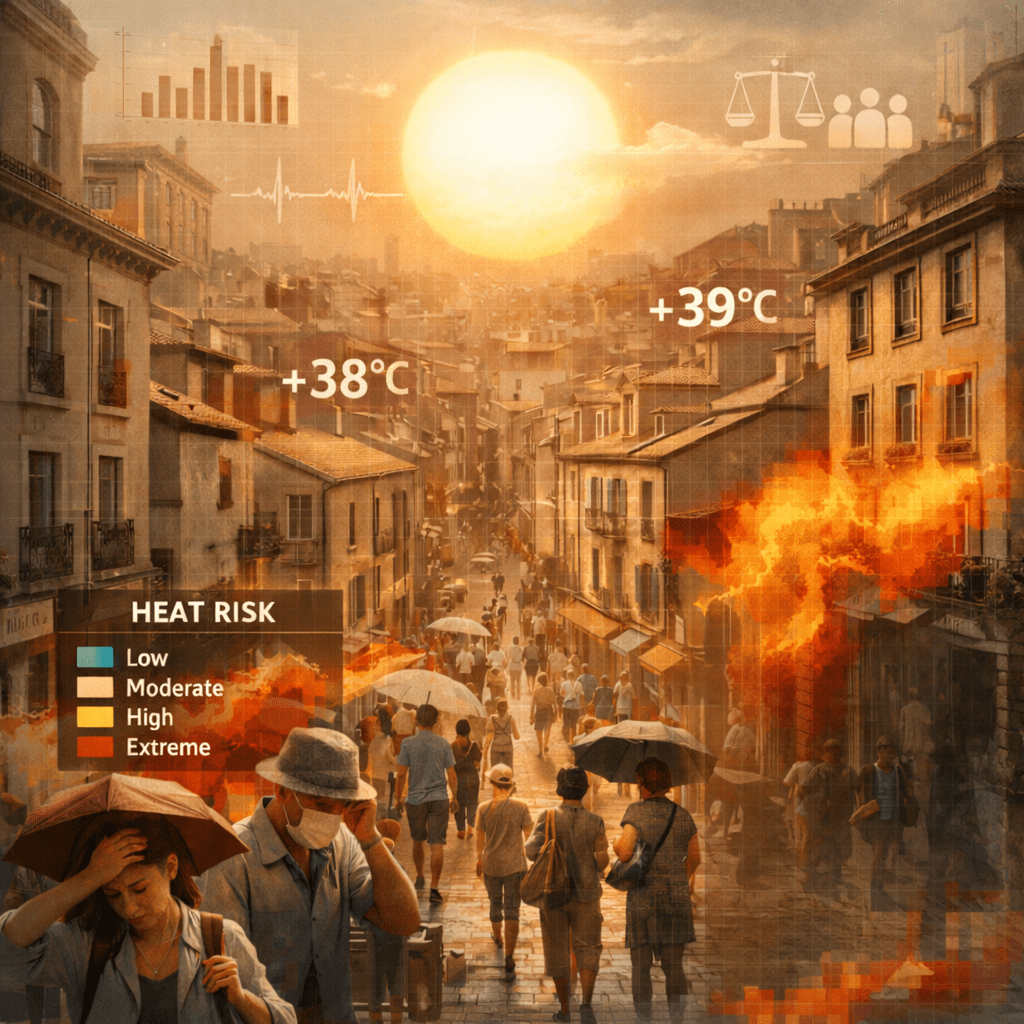
Europe is no longer facing occasional extreme heat events. Heatwaves have become a persistent public health challenge, claiming thousands of lives and exposing structural weaknesses in how societies protect their most vulnerable populations. While rising temperatures are often cited as the main driver of heat-related deaths, new research suggests that social and spatial factors may play an even greater role in determining who survives and who does not.
A new continental-scale study led by Benedetta Sestito and colleagues provides one of the most comprehensive assessments to date of heatwave mortality across Europe. Published in Environmental Research Letters under the title “Identifying vulnerability factors associated with heatwave mortality: a spatial statistical analysis across Europe”, the research was conducted at the Institute for Environmental Studies, Vrije Universiteit Amsterdam. The study moves beyond temperature alone and demonstrates that vulnerability to heat is shaped by urbanisation patterns and social inequality as much as by climate itself.
By analysing two decades of mortality data, the study reveals that urban expansion and the proportion of residents with foreign citizenship are among the strongest predictors of heatwave-related deaths. These findings challenge conventional climate risk narratives and place human vulnerability, rather than heat intensity alone, at the centre of Europe’s warming crisis.
Why heatwaves are becoming a silent public health emergency
Heatwaves exert profound physiological stress on the human body. Extreme heat disrupts thermoregulation, increases dehydration, alters cardiovascular function, and can trigger organ failure. These effects are particularly dangerous for individuals with pre-existing health conditions, limited access to cooling, or delayed medical intervention.
Europe has already experienced the devastating consequences of extreme heat. The 2003 summer heatwave alone resulted in more than 70,000 excess deaths across Western Europe. Since then, climate change has increased both the frequency and intensity of heat extremes, turning what was once an episodic threat into a chronic risk to population health.
Despite this growing danger, most heat risk assessments continue to prioritise meteorological indicators such as maximum temperature or heatwave duration. While these factors are important, they fail to explain why similar heat events result in drastically different mortality outcomes across regions. The study addresses this gap by systematically examining how vulnerability factors interact with heat exposure at a continental scale.
A Europe-wide analysis grounded in real mortality data
One of the defining strengths of this research lies in its scope and methodology. The authors analysed heatwave-related fatalities recorded between 2000 and 2019 across European NUTS2 regions, using data derived from the EM-DAT disaster database. These mortality records were combined with high-resolution climate reanalysis, population exposure estimates, and a broad set of socioeconomic and demographic indicators.
Unlike many vulnerability indices that rely on theoretical weighting schemes, this study employed ordinary least squares regression to statistically identify which factors most strongly explain observed heatwave mortality. The analysis incorporated hazard characteristics such as apparent temperature and heatwave duration, exposure measured as population affected, and vulnerability variables including age structure, income, education, healthcare accessibility, urbanisation, and foreign citizenship.
Crucially, the researchers validated their vulnerability assessment directly against recorded mortality outcomes. This approach strengthens the credibility of the findings and helps bridge the gap between academic vulnerability theory and real-world health impacts.
-Benedetta Sestito
The heat vulnerability index and what it reveals
Based on the regression results, the authors developed a European Heat Vulnerability Index covering the period from 2000 to 2019. The index quantifies vulnerability as a weighted combination of statistically significant drivers, enabling the mapping of spatial and temporal patterns across the continent.
Among all variables tested, two factors consistently emerged as dominant predictors of heatwave mortality. These were the proportion of residents with foreign citizenship and the extent of urban cluster areas within a region.
According to the final model, a one percent increase in the share of foreign citizens was associated with a 12.1 percent increase in heatwave-related mortality. Similarly, a one percent increase in urban cluster area corresponded to a 7.3 percent rise in deaths during heat events. These effects remained robust even after accounting for country-specific characteristics and population exposure.
In contrast, several variables often assumed to be critical, including age distribution and land surface temperature, did not significantly improve the model’s explanatory power at the continental scale. This finding highlights the significance of social and spatial context in influencing climate health outcomes.
Foreign citizenship and the role of social vulnerability
Perhaps the most novel and sensitive finding of the study concerns the role of foreign citizenship as a vulnerability driver. The authors emphasise that foreign citizenship is not a biological risk factor, but rather a proxy for a constellation of socioeconomic disadvantages.
Foreign residents may face language barriers that limit access to heat warnings or healthcare services. They are more likely to work in outdoor or physically demanding occupations, live in substandard housing, or experience economic insecurity. These conditions can reduce adaptive capacity and increase exposure during extreme heat events.
Importantly, the study does not claim that foreign status itself causes higher mortality. Instead, it draws attention to structural inequalities that intersect with migration status. The findings echo climate justice research from other regions, suggesting that socially marginalised groups bear a disproportionate burden of climate-related health risks.
Reference
Sestito, B., Reimann, L., Mazzoleni, M., Botzen, W. J. W., & Aerts, J. C. J. H. A. (2025). Identifying vulnerability factors associated with heatwave mortality: a spatial statistical analysis across Europe. Environmental Research Letters, 20(4), 044025. https://doi.org/10.1088/1748-9326/adbcc8