
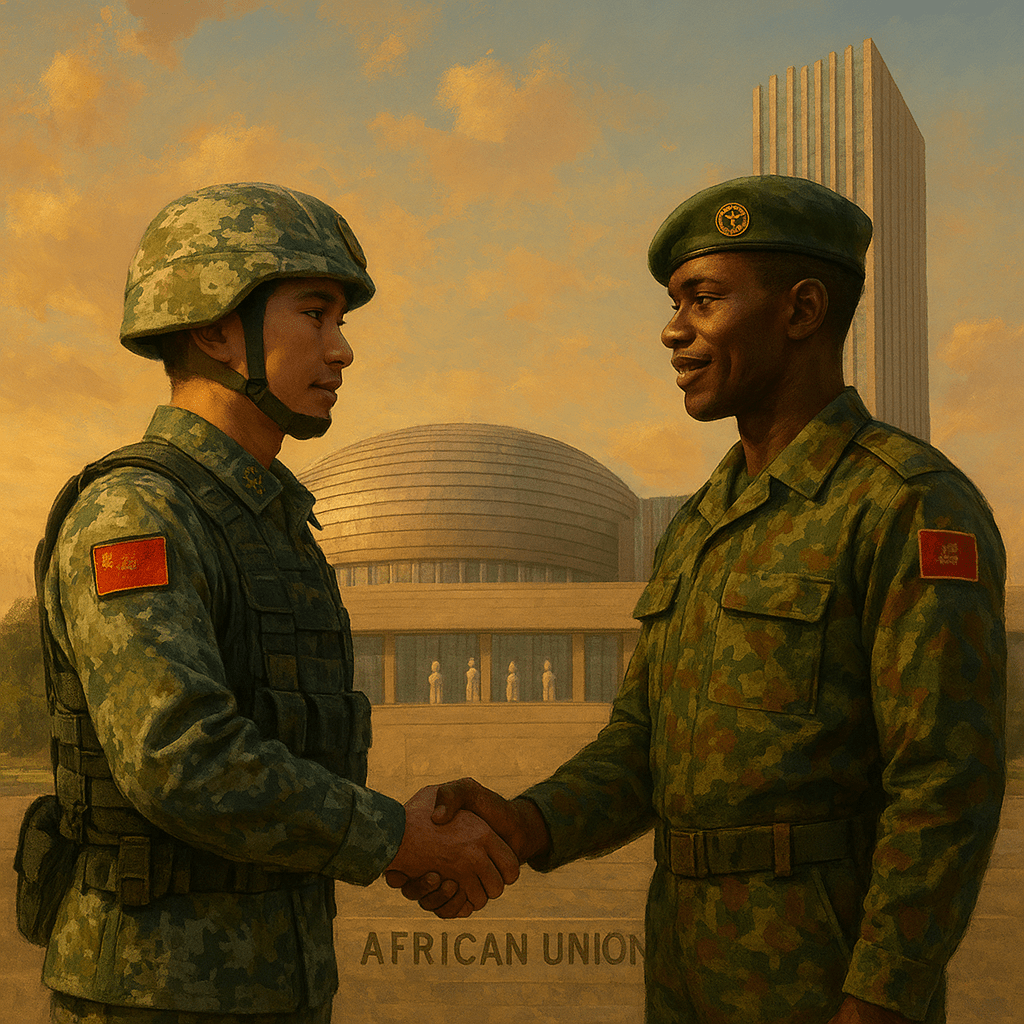
When most people think of China in Africa, they imagine highways, railways and vast infrastructure projects built under the Belt and Road Initiative. Yet a new study shows Beijing is now increasingly turning its gaze toward security. China is not only investing in Africa’s growth but also protecting its stakes through military cooperation, diplomacy and institutional partnerships. This evolution marks a dramatic shift in global geopolitics.
In a recent article published in the European Journal of International Security, political scientist Georg Lammich from the University of Duisburg-Essen explores this transformation in detail. His study, China’s evolving security engagement in Africa: Policies, strategies, and implications, examines case studies from Tanzania, Ethiopia and the African Union (AU). By weaving together interviews, document analysis and policy review, Lammich reveals how Beijing is carefully but steadily embedding itself as a security actor on the continent.
From trade partner to security player
For years, China’s relationship with Africa was dominated by roads, ports and loans. The country was seen primarily as an economic partner, building infrastructure in exchange for access to natural resources. Yet as Chinese nationals, companies and investments spread across the continent, Beijing faced a pressing question: how to protect them in fragile and conflict-prone regions?
The answer, according to Lammich’s findings, has been to integrate hard security measures such as arms transfers, troop training and even military bases with soft security approaches that emphasise diplomacy, conflict mediation and peacekeeping. This dual strategy enables Beijing to secure its investments while projecting itself as a responsible global actor.
China’s approach is not revolutionary. Western powers have long tied development to security, particularly in Africa. What makes Beijing different is its distinct discourse of South-South cooperation and non-interference. This narrative reassures African governments wary of foreign intervention, yet the reality is more complex. The research reveals that China’s presence is expanding into areas once reserved for traditional powers, raising questions about balance and influence.
Tanzania as a military partner
One of the most striking examples comes from Tanzania. The country’s military relationship with China dates back to the 1960s and remains one of the strongest in Africa. Under President Julius Nyerere, Tanzania received weapons, training and aircraft from Beijing. Decades later, this cooperation has only deepened.
China has supplied Tanzania with amphibious tanks, short-range air defence systems and rocket launchers. The two countries conduct joint naval drills and military exercises such as Peace Unity-2024, which allowed the People’s Liberation Army (PLA) to demonstrate expeditionary capabilities while strengthening bilateral ties. In addition, Beijing has financed training centres and built housing for Tanzania’s defence forces.
These exchanges are not limited to technology. Chinese influence is embedded in training programmes, military medicine and logistics. Critics argue such cooperation risks undermining Tanzania’s non-aligned foreign policy, pulling the country closer to Beijing’s orbit. Supporters, however, see this as a modernisation opportunity for the Tanzania People’s Defence Force. Either way, the partnership illustrates how China is moving beyond trade into strategic military engagement.
Ethiopia and diplomatic manoeuvres
While Tanzania highlights military cooperation, Ethiopia underscores Beijing’s growing role as a diplomatic actor. Ethiopia has received billions in Chinese loans and investments in railways, dams and industrial parks. Yet since 2020, the country has been torn apart by the Tigray conflict, a civil war that has claimed tens of thousands of lives.
During the conflict, China resisted calls at the United Nations Security Council for intervention, citing sovereignty. This stance angered Western powers but earned appreciation from Ethiopia’s government. At the same time, Beijing could not ignore its economic exposure. Chinese companies suspended projects, and hundreds of nationals were forced to evacuate.
In response, China launched the Initiative for Peaceful Development in the Horn of Africa. Foreign minister called for regional unity and appointed a special envoy to mediate. Conferences were held in Addis Ababa and Beijing under the framework of China’s Global Security Initiative. Although Beijing’s mediation was limited and often criticised as favouring incumbents, it signalled a new willingness to act as a peace facilitator.
This balancing act between sovereignty, diplomacy and economic interest reflects China’s cautious but calculated approach. Ethiopia demonstrates how Beijing experiments with conflict resolution, not to displace Western actors, but to safeguard its reputation and investments.
The African union connection
Beyond bilateral ties, China has increasingly worked through the African Union. Its policies endorse African-led initiatives such as the African Standby Force and the Capacity for Immediate Response to Crises. Beijing provides funding, training and logistical support, positioning itself as a partner rather than a hegemon.
China’s participation in United Nations peacekeeping is particularly notable. It sends more peacekeepers to Africa than any other permanent member of the Security Council and is the second-largest financier after the United States. As of early 2023, over two thousand Chinese troops and police served in African missions. The PLA Navy conducts regular anti-piracy patrols in the Gulf of Aden and the Gulf of Guinea, protecting trade routes vital to China’s economy.
These efforts allow Beijing to brand itself as a provider of global public goods while simultaneously advancing its strategic interests. The African Union thus becomes both a stage and a partner for China’s ambition to shape security governance.
Motivations behind china’s actions
Why is Beijing so invested in Africa’s security? Lammich frames the answer through realism. Core realists argue intervention is rational if it secures Chinese citizens and assets at relatively low cost. Economic realists see security as essential to protecting trade, oil and mineral flows. Normative realists emphasise prestige, suggesting China’s involvement enhances its credibility as a global power. Finally, ethical realists consider the moral dimension, where intervention aligns with China’s claim to be a responsible actor.
These motives converge in Africa. Civil wars in Libya, South Sudan or Ethiopia have directly disrupted Chinese projects. Attacks on nationals, piracy and terrorism pose constant risks. By engaging, Beijing protects its investments, satisfies domestic audiences, and builds international legitimacy.
At the same time, China is careful to maintain its doctrine of non-interference. It avoids sanctions or regime change strategies, focusing instead on stability and incumbency. This has led to criticism that China props up authoritarian regimes. Yet for Beijing, stability is paramount, both at home and abroad.
The global security initiative
Central to China’s evolving strategy is the Global Security Initiative (GSI), announced by President Xi Jinping in 2022. The GSI promotes principles of indivisible security, respect for sovereignty and cooperative problem-solving. While critics view it as a vague counter-narrative to Western-led security, in Africa it provides a framework for expanded activity.
Under the GSI, China has bundled military aid, training and conflict mediation into a cohesive vision. The initiative links security to development, echoing Beijing’s long-held belief that economic growth underpins peace. Yet unlike Western models that stress democracy and governance, China prioritises stability and sovereignty.
This difference resonates with many African leaders who resent external interference. At the same time, it raises questions about whether China’s approach truly addresses underlying political grievances or merely preserves the status quo.
Challenges and contradictions
Despite its growing role, China’s engagement faces limitations. Its diplomacy in Ethiopia was overshadowed by African-led mediation. Its arms sales have been criticised for fuelling conflicts. Its emphasis on sovereignty sometimes clashes with humanitarian concerns. Moreover, African societies are not monolithic. Some view China as a partner of opportunity, others as a new source of dependency.
There is also the risk of entanglement in great power rivalry. As the United States and Europe recalibrate their Africa strategies, Beijing’s expanding footprint could spark competition. African governments may find themselves navigating between powers in ways reminiscent of Cold War alignments.
What this means for the future
China’s security engagement in Africa is still cautious, but it is steadily expanding. From military training in Tanzania to peace initiatives in the Horn of Africa, Beijing is testing its ability to act beyond economics. Whether this leads to a new model of international cooperation or simply a different form of influence remains to be seen.
For Africa, China represents both opportunity and challenge. Greater support for peacekeeping and security infrastructure can strengthen local capacity. Yet heavy reliance on a single external actor risks undermining sovereignty and diversity of partnerships. For the global community, Beijing’s actions in Africa provide a window into how China envisions its role as a world power.
As Lammich’s study concludes, the shift from builder of roads to provider of security reflects more than strategy. It reflects China’s determination to protect its global interests and reshape international norms. Africa is both a testing ground and a stage for this ambition.
Reference
Lammich, G. (2025). China’s evolving security engagement in Africa: Policies, strategies, and implications. European Journal of International Security. Cambridge University Press. https://doi.org/10.1017/eis.2025.3