Italy’s dependence on Russian gas is often interpreted as a recent geopolitical vulnerability. In reality, it is the outcome of a long-term historical process shaped by structural energy scarcity, economic pragmatism, and strategic policy decisions.
This article traces the origins of this dependence from the post-war period to the end of the Cold War, highlighting the role of Enrico Mattei, the emergence of natural gas as a strategic resource, and the progressive consolidation of energy relations with the Soviet Union.
Particular attention is given to key turning points, including the oil crises of the 1970s, the construction of the West Siberian Pipeline, and Italy’s decision to abandon nuclear energy after the Chornobyl disaster.
The origin of a dependence
Italy has historically had limited domestic energy resources. This condition has deep roots and has influenced the country’s industrial development. As a result, Italy has increasingly relied on imported energy and has therefore been compelled to negotiate with the most advantageous suppliers. This dependence became more evident as fossil fuels assumed a central role within the global energy system.
Enrico Mattei: The oilman without oil
After the Second World War, Italy’s energy needs were addressed by Enrico Mattei, an entrepreneur and former partisan who founded ENI (Ente Nazionale Idrocarburi) in 1953. For a limited period, until his death in a suspicious plane crash in October 1962, Italy pursued an oil policy that challenged the dominance of the major international companies, the so-called “Seven Sisters”, which controlled the entire fuel cycle, from exploration to extraction and distribution.
In this context, the royalties granted to producing countries were deliberately kept low. Mattei, often referred to as “the oilman without oil”, understood that by offering more favourable conditions, Italy could secure advantageous agreements. This approach, known as the “Mattei formula”, disrupted the monopoly of the Seven Sisters and enabled producing countries to obtain higher royalties. It also contributed to the broader process that led to the creation of OPEC in 1960.
The role of natural gas
One of the countries towards which Mattei directed his interest was the Soviet Union. The first agreement, signed in 1958, already included significant quantities of natural gas. In this sense, Mattei was among the first to recognise the importance of this resource.
During the final stages of the Second World War, significant natural gas reserves were discovered in northern Italy, particularly in Caviaga, in the Po Valley. Mattei sought to exploit these resources as part of a strategy to achieve greater national energy autonomy.
Before this period, natural gas had been used only in limited cases, mainly in North America and close to production sites. When discovered instead of oil, it was often considered of little value and even flared. Only with Mattei did natural gas begin to emerge as a viable alternative to oil.
However, Italian reserves proved insufficient, necessitating a turn to foreign sources. In this context, the economic conditions offered by the Soviet Union appeared particularly advantageous.
The Soviet choice
The decision to assign a central role to natural gas in Italy’s energy security strategy took shape in 1967, following the first closure of the Suez Canal, a crucial hub for Mediterranean trade, including oil transport.
From that moment, several governmental meetings were held to identify the most viable and convenient energy alternatives. These discussions led to the definition of long-term strategic guidelines, including the decision to prioritise natural gas and to pursue agreements with major suppliers such as Algeria, the Netherlands, and the Soviet Union.
Among these options, strongly supported the Soviet offer, which guaranteed both continuity of supply and lower costs. In addition, it allowed payments through the export of goods and via pipeline infrastructure.
Although negotiations were conducted with all three partners, a preference for Soviet gas gradually emerged, as it was more economical and compatible with the barter system Mattei used. This system involved the exchange of crude oil for Italian industrial products directly within contractual agreements, making cooperation with Moscow particularly advantageous.
Italy and the oil crises
Despite these efforts, Italy was unprepared for both the first oil shock (1973) and the second (1978–79), largely because of its heavy reliance on imported oil, which accounted for more than 70% of national energy consumption.
Several factors contributed to this situation, including the failure to develop nuclear energy for peaceful purposes. In response to the crises, Italy attempted to formulate and subsequently refine a national energy plan, while also seeking new agreements with fossil fuel producers.
In particular, the government renewed its focus on natural gas. Agreements with Algeria and the Soviet Union were concluded amid rising oil prices that also affected gas markets. Although costs increased, energy supply remained a priority, and Italy accepted more onerous contractual conditions.
Nevertheless, among the available options, Soviet gas remained the most advantageous, especially after the discovery of the large Urengoy gas field in Western Siberia.
The most important partnership: The West-Siberian Pipeline
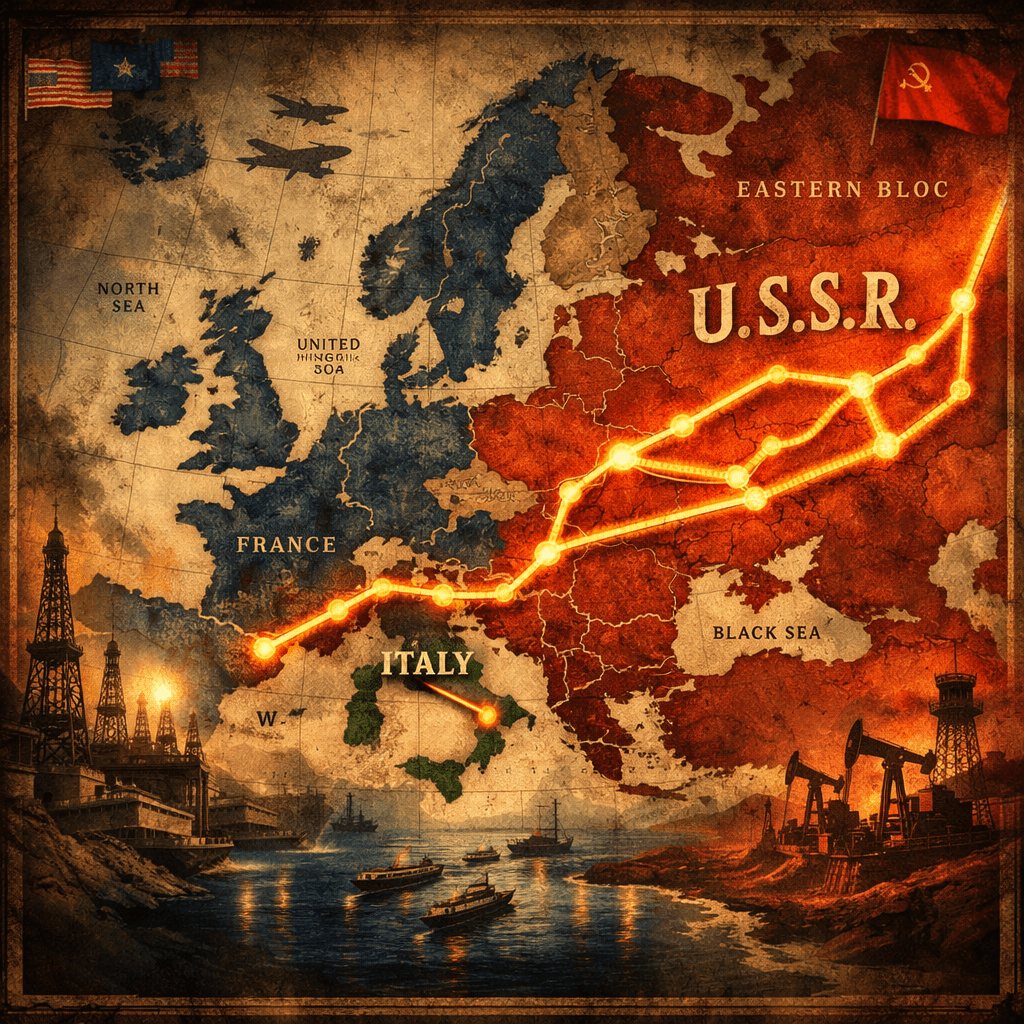
At the end of the 1980s, the Soviet Union began construction of the West Siberian Pipeline in the Trans-Ural region. This infrastructure was designed to transport natural gas from the Urengoy field to Ukraine and then to Europe.
The project, initially proposed to West Germany, France, and Italy, was strongly opposed by the United States, which sought to limit Europe’s growing dependence on Soviet energy during the Cold War.
Despite these pressures and after some hesitation, Italy joined the project in 1984.This agreement represented a crucial step in consolidating Italy’s dependence on Soviet natural gas.
The situation after the abandonment of nuclear energy
The 1984 agreement marked a turning point in Italy’s energy policy, reinforcing its reliance on Soviet gas. At the same time, these developments were closely linked to broader geopolitical dynamics during the Cold War. This dependence became even more pronounced after the Chornobyl disaster and the subsequent decision, confirmed by the 1987 referendum, to abandon nuclear energy.
Energy relations with the Soviet Union continued in the following years and, after a temporary slowdown following the collapse of the Soviet regime, resumed with Gazprom, established in 1989.
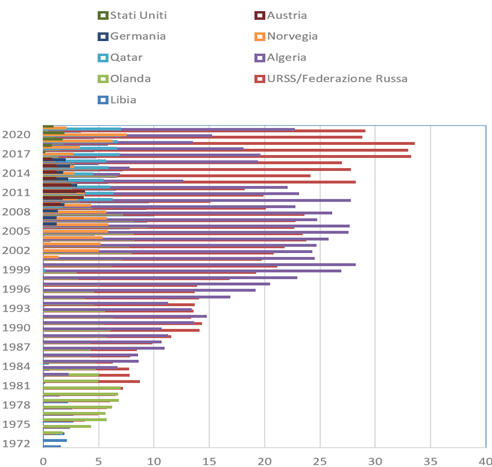
Over time, this dependence increased further, also at the European level, particularly with the construction of major pipelines such as Yamal-Europe. In 2021, on the eve of Russia’s invasion of Ukraine, approximately 29 billion cubic meters of gas, around 40% of Italy’s total supply, were imported from Russia.
By examining these developments, the article shows how economic convenience, infrastructural investments, and political choices combined over time to produce a structural, enduring dependence that remains highly relevant in the contemporary energy landscape.
Reference
Labbate, S. (2026). Italy and Soviet gas: the history of a dependence (1960–1984). Cold War History, 1-20. https://doi.org/10.1080/14682745.2025.2529254