When policymakers discuss reducing transport emissions, most plans focus on city centers. Yet new research from Anna Charly of the University of Liverpool and Brian Caulfield from Trinity College Dublin, published in Sustainable Futures, suggests that Ireland may be looking in the wrong direction. The study introduces a detailed bottom-up transport emission model that reveals a surprising pattern. Rural counties could reduce more carbon dioxide per electric vehicle than urban areas because their drivers travel far longer distances.
The paper, titled Transport emission modelling based on a bottom up approach to facilitate sustainable transport planning, offers a new way to estimate street level pollution. It challenges long-held assumptions about how electric vehicles should be deployed and raises questions about spatial equity, decarbonisation pathways, and climate action planning.
A shift from top-down to street-level science
For decades, governments relied on top-down emission models to understand transport pollution. These models calculated emissions using national vehicle stock, fuel use, and population data. They could identify trends but were unable to capture the fluctuations that occur at specific junctions or corridors during peak hours.
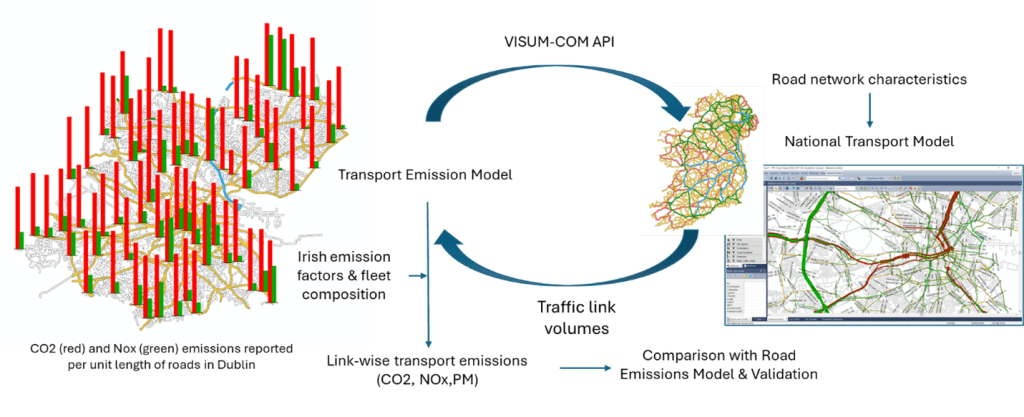
The new study moves past this limitation. It applies a bottom-up modelling framework that combines the National Transport Model for Ireland, detailed road link attributes, and granular vehicle fleet composition. More than 250000 road links and 979 transport zones were analysed, allowing emissions to be estimated with considerable spatial and temporal accuracy.
This level of detail has practical value. Schools, hospitals, and vulnerable communities often sit near traffic corridors that experience peak-hour spikes. A bottom-up system can estimate such link-based emissions and guide policies that address real exposure risk rather than averaged national trends.
Could disparities in cleaner transport investment between urban and rural regions be costing us more than we think? Bottom-up emission models offer a way to uncover these hidden inequities and support a more streamlined and just green transition.
—Anna Charly
Building the model that sees every road
The transport emission model integrates data through the VISUM platform using an application programming interface. Traffic volumes for each road link are imported from the national travel demand model. These volumes are matched with emission factors for CO2, NOx, and PM2.5, covering a full range of vehicle and fuel types, including diesel, petrol, hybrid, and electric.
The study uses Irish fleet statistics and European emission factor datasets to calculate pollutant levels per kilometre. It also accounts for non-exhaust emissions from electric vehicles. This is significant because tyre and road wear continue to produce PM2.5 even in the absence of tailpipe exhaust.
By combining these elements, the researchers generate a high-resolution picture of pollution across Ireland. The model can be adapted for other countries simply by substituting local fleet compositions and emission factor databases, making it a potentially valuable tool for global sustainable transport planning.
What the model reveals about urban and rural emissions
While Dublin and Cork produce the highest total emissions, rural counties generate significantly higher emissions per vehicle due to longer average trip distances.
Data extracted from national traffic flows show that an average car in Kildare travels 20453 kilometres per year. This is nearly twice the distance traveled by an average car in Dublin, which stands at 10,404 kilometers. Similar patterns appear in Laois, Westmeath, Meath, and Roscommon. The trend is clear. Rural drivers cover more ground and, therefore, generate more emissions per vehicle.
Yet electrification has not kept pace. Dublin and Cork account for 54.8 percent of all electric vehicle sales, while many rural counties remain far behind. Kildare, despite its high mileage, represents only around 11 percent of national electric vehicle sales.
The surprising advantage of rural electrification
The model shows that electrifying a single vehicle in a rural county results in fewer emissions than electrifying one in an urban region.
Replacing a petrol or diesel car with an electric vehicle in Kildare can eliminate 3.4 kilograms of carbon dioxide during a single morning peak hour. In Dublin, the equivalent figure is 1.5 kilograms, and in Cork it is 2.2 kilograms.
This difference becomes important when scaled across full commuting populations. The paper suggests that focusing electric vehicle subsidies and charging infrastructure exclusively on large cities may miss an opportunity for deeper emissions cuts elsewhere.
Testing future scenarios for sustainable transport
Two scenarios were evaluated. The first redistributed a proportion of new electric vehicles to ten rural counties with long annual travel distances. The second concentrated the same proportion of vehicles in Dublin and Cork, where electric vehicle uptake is already high.
Scenario two resulted in the largest total reduction in carbon dioxide and nitrogen oxides, as these cities have high overall travel demand. However, it also led to a slight increase in PM2.5, driven by non-exhaust emissions from heavier electric vehicles in densely trafficked areas.
Scenario one produced smaller total reductions but delivered consistent decreases across all pollutants, including PM2.5. The modeling demonstrates that rural electrification yields greater benefits per vehicle, while urban electrification yields greater system-wide benefits. Policymakers must therefore balance both outcomes when designing climate strategies.
A new lens on spatial inequality in climate policy
The findings raise questions about fairness in Ireland’s transition to low-emission mobility. Urban residents benefit from easy access to charging points, stronger public transport and higher availability of electric vehicle grants. Rural residents, who travel the farthest and have few alternatives, remain constrained by limited charging infrastructure and higher upfront costs.
This research suggests that electrification strategies should be geographically targeted. Rural counties with high vehicle mileage could achieve meaningful emission reductions if they were given better access to the technologies driving the green transition. Without such adjustments, the gap between urban and rural transport emissions is likely to widen.
Why PM2.5 remains a concern even in an electric future
The study also highlights a growing issue in sustainable mobility. While electric cars remove tailpipe pollutants, they still contribute to non-exhaust particulate matter. PM2.5 remains one of the most harmful pollutants for public health, linked to respiratory and cardiovascular disease.
In dense cities where vehicle speeds fluctuate and braking events are frequent, non-exhaust emissions may exceed expectations. The slight increase in PM2.5 in the urban electrification scenario highlights the need to align electric vehicle policies with investments in public transportation, cycling infrastructure, and reduced car dependency.
What this means for Ireland’s climate goals
Ireland aims to reduce transport emissions in line with European Union targets, including a 55% reduction by 2030. Achieving this requires granular data on the origin of emissions and how various technologies can reduce them.
The model developed by Anna Charly and Brian Caulfield offers such granularity. It provides a realistic tool for policymakers evaluating electric vehicle strategies, scenario planning, sustainable transport investments, and resource allocation for charging infrastructure.
Its ability to estimate emissions at the road link level and integrate multiple vehicle technologies positions it as an important resource for future climate action frameworks.
As Ireland scales its electric vehicle targets, allocating resources strategically rather than uniformly may deliver faster progress and greater fairness. This study provides the evidence needed to support a more geographically balanced transition.
This work was supported by Science Foundation Ireland and Microsoft under the project Terrain-AI.
Reference
Charly, A., & Caulfield, B. (2025). Transport emission modelling based on a bottom up approach to facilitate sustainable transport planning. Sustainable Futures, 9, 100435. https://doi.org/10.1016/j.sftr.2025.100435
Coauthor

Prof Caulfield is a Professor in Transportation in the Department of Civil, Structural, and Environmental Engineering and a Fellow of Trinity College Dublin. Since joining the Department, he has embarked on an intensive research program addressing the environmental impacts of transport and methods to reduce its carbon footprint, and in 2017, he addressed the Irish Citizens’ Assembly on this topic. He recently provided advice to the Climate Change Advisory Council on pathways to decreasing transport emissions by 2030. He has published over 200 papers in high-impact international journals and has been awarded approximately €12 million in research funding.