
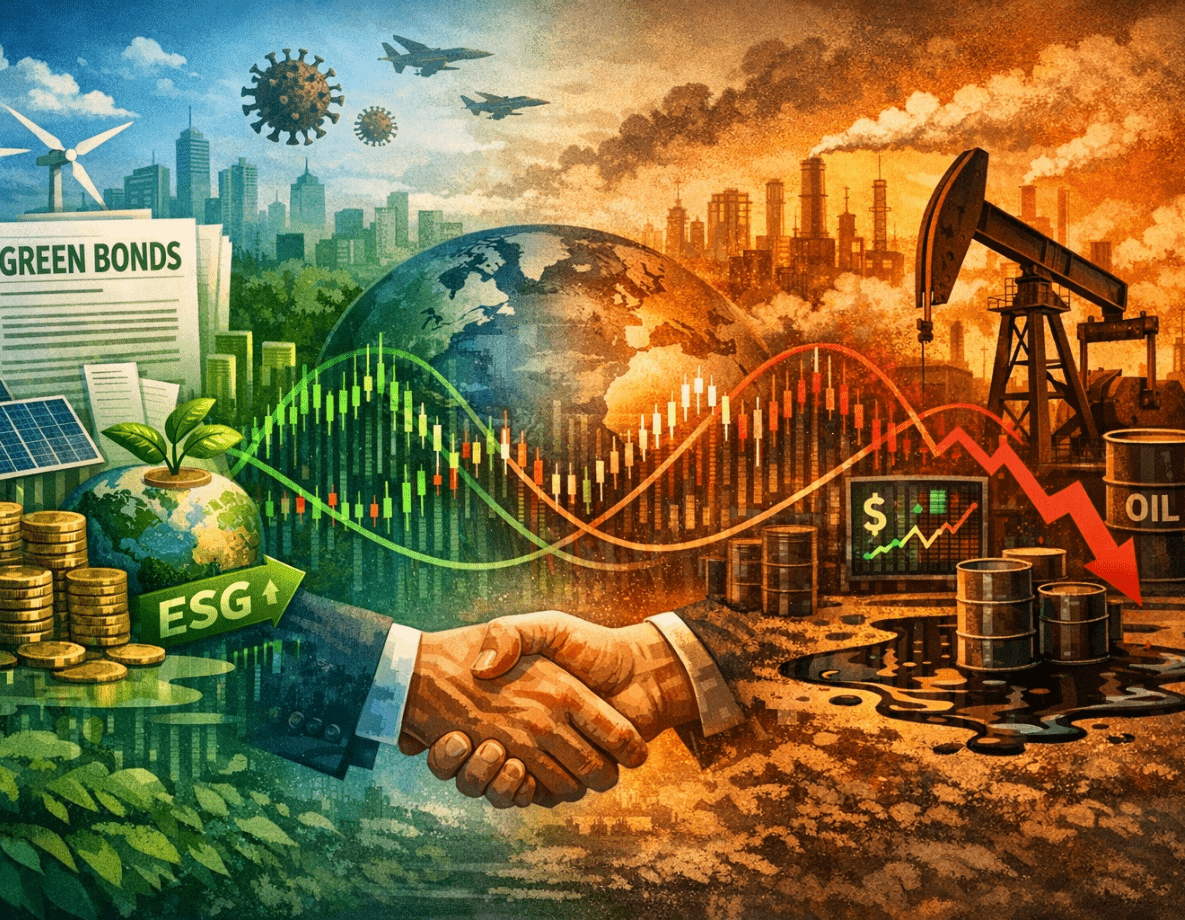
The global transition toward a low-carbon economy is unfolding in a complex financial landscape shaped by both traditional energy markets and emerging sustainable instruments. Among these, green bonds have emerged as a critical vehicle for financing environmentally sustainable projects, while crude oil continues to exert a powerful influence on global economic cycles. Understanding the dynamic linkages between these two seemingly contrasting domains, i.e., fossil fuels and green finance, is essential for designing resilient climate financing strategies.
Recent empirical evidence from the New Delhi Institute of Management, published in Computational Economics, highlights a nuanced relationship between oil prices and green bonds. While volatility spillovers between the two markets appear limited, suggesting a degree of insulation of green bonds from oil market turbulence, deeper analysis reveals long-term connectedness and episodic co-movement. These co-movements become particularly pronounced during periods of global crisis, such as the COVID-19 pandemic and geopolitical disruptions. This pattern underscores a broader financial reality: in times of systemic stress, asset classes that typically behave independently tend to move together, driven by heightened uncertainty and synchronized investor behaviour.
Why this relationship matters for investors
From a climate finance perspective, this duality of short-term independence but long-term integration presents both challenges and opportunities. On the one hand, the relative stability of green bonds amid oil price volatility enhances their attractiveness as a diversification tool. Investors seeking refuge from the cyclical nature of fossil fuel markets may find green bonds a compelling alternative, especially during periods of moderate economic activity.
On the other hand, the observed long-term cointegration suggests that green bonds are not entirely decoupled from the broader energy ecosystem. Structural shifts in oil markets, whether due to supply shocks, technological changes, or policy interventions, can have lasting implications for green finance.
How crises reshape financial connections
One of the most important insights from this relationship is the role of crises as catalysts for financial interdependence. During turbulent periods, the increased co-movement between oil prices and green bonds reflects a convergence of investor sentiment. Risk aversion rises, liquidity preferences shift, and even fundamentally distinct assets begin to exhibit synchronized behavior.
For policymakers, this implies that climate financing strategies cannot be designed in isolation from macro-financial stability considerations. Instead, they must account for the systemic nature of financial markets, where shocks in one segment can reverberate across others.
Designing more resilient green bond markets
To address these challenges, a more adaptive and layered approach to green bond design is required. A tiered structure of green bonds, differentiated by maturity and risk-return profiles, can cater to diverse investor needs. Short-term green bonds with higher liquidity can appeal to risk-averse investors during volatile periods, while long-term instruments with embedded sustainability incentives can attract institutional investors committed to environmental goals. Such segmentation not only broadens the investor base but also enhances market resilience by reducing concentration risks.
Liquidity provision emerges as another critical pillar of climate finance stability. The establishment of green bond reserve facilities, potentially backed by central banks or multilateral institutions, can act as a buffer during periods of market stress. By intervening as buyers of last resort, these entities can stabilize prices, prevent panic-driven sell-offs, and maintain investor confidence. This is particularly important given the relatively nascent nature of green bond markets, which may be more susceptible to liquidity shocks compared to traditional fixed-income markets.
Linking financial returns to sustainability outcomes
Innovation in financial structuring can further strengthen the link between environmental performance and investor returns. Mechanisms such as coupon step-ups tied to sustainability milestones introduce a performance-based dimension to green bonds. These structures align financial incentives with environmental outcomes, ensuring that capital allocation is not only green in intent but also effective in impact. At the same time, they appeal to a broader spectrum of investors, bridging the gap between purely profit-driven and mission-oriented investment strategies.
Green finance is not detached from fossil fuels—it is dynamically shaped by them.
—Haseen Ahmed
How technology is transforming climate finance
The integration of advanced financial technologies also holds significant promise. Machine learning and deep learning models can enhance the predictive capabilities of policymakers and market participants, enabling the development of early-warning systems for market turbulence. By forecasting the impact of oil price fluctuations on green bond markets, these tools can inform more timely and effective policy interventions. Transparency in sharing such forecasts can further strengthen market confidence, fostering a more informed and resilient investment environment.
Another avenue for strengthening climate finance is the development of dynamic investment vehicles, such as green bond exchange-traded funds (ETFs). These instruments, with built-in rebalancing mechanisms, allow investors to adjust their exposure in response to changing market conditions, including fluctuations in oil prices. By offering liquidity, diversification, and flexibility, green bond ETFs can attract a wider pool of investors, including those with shorter investment horizons.
Equally important is the role of regulatory frameworks and disclosure standards. The credibility of green bonds hinges on the transparency and accountability of issuers. Mandatory sustainability reporting, with standardized metrics and frequent updates, can mitigate concerns about greenwashing and enhance investor trust. In a market where long-term commitments are essential, credible disclosures serve as a cornerstone for sustained capital inflows.
Rethinking the architecture of climate finance
The broader implication of the oil–green bond nexus is the need to rethink the architecture of climate finance. Rather than viewing green bonds as a standalone solution, they must be integrated into a holistic financial ecosystem that acknowledges the enduring influence of fossil fuel markets. This includes aligning issuance strategies with macroeconomic cycles, leveraging periods of heightened investor interest, and ensuring that green finance remains competitive even when oil markets are buoyant.
At the same time, the findings point to significant opportunities for portfolio diversification. The varying degrees of co-movement between oil prices and green bonds across different time horizons suggest that investors can strategically allocate assets to optimize risk-adjusted returns. During stable periods, green bonds can provide steady income with lower correlation to oil markets, while during crises, dynamic reallocation strategies can help mitigate synchronized downturns.
What comes next for climate finance research
Looking ahead, the evolution of climate finance will depend on the ability to navigate this complex interplay between traditional and sustainable assets. Expanding the scope of research to include additional macro-financial variables, cross-market comparisons, and behavioural dimensions can provide deeper insights into investor decision-making and market dynamics. The incorporation of advanced analytical techniques, including explainable artificial intelligence, can further enhance the robustness and interpretability of these insights.
In conclusion, the relationship between oil prices and green bonds is emblematic of the broader transition underway in global finance. It reflects the tension between legacy energy systems and the emerging sustainability paradigm. By recognizing and addressing the interconnectedness of these domains, policymakers and market participants can design more resilient, inclusive, and effective climate financing mechanisms. In doing so, they can not only mitigate the risks associated with market volatility but also accelerate the transition toward a more sustainable and equitable economic future.
Reference
Ahmed, H. (2026). Green Bonds and Crude Oil Prices: Exploring Dynamic Linkages and Implications for Climate Financing. Computational Economics, 1-27. https://doi.org/10.1007/s10614-026-11311-0